


Fasto at Canton Fair 2026: A Top 10 Chinese Fastener Manufacturer Responding to Global Green Compliance and High-Performance Demands
Why Is CBAM Now a Key Requirement for Fastener Buyers?
For European buyers especially, CBAM has become a core part of sourcing decisions. It is no longer just about reporting emissions. Suppliers are expected to provide data that buyers can actually use.
This includes:
- Traceable material origins
- Surface treatments aligned with environmental regulations
- Cleaner and more controlled production processes
What buyers are actively asking for:
- Trivalent chromium instead of hexavalent
- Non-electrolytic coatings such as Geomet or Dacromet
- Stainless steel solutions that reduce coating dependency
“CBAM-compliant” is no longer a label—it is a requirement to reduce customs risk and ensure smooth market entry.
Fasto maintains controlled coating processes and transparent sourcing to support both compliance documentation and consistent product performance.

How Does RoHS Compliance Influence Fastener Selection?
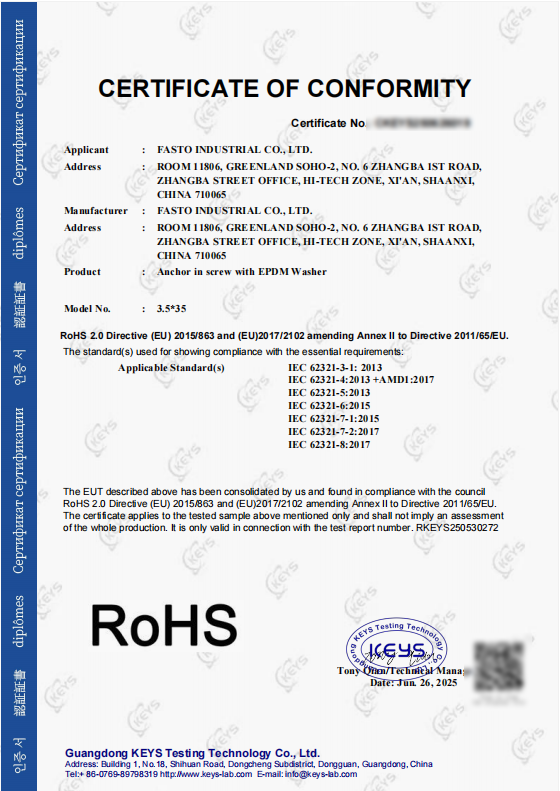
RoHS (Restriction of Hazardous Substances) has become a baseline requirement in many markets, especially in Europe.
For fasteners, this mainly affects:
- Surface treatment chemicals
- Plating processes
- Material composition and trace elements
In practice, buyers are checking for:
- Use of trivalent chromium instead of hexavalent chromium
- Reduced hazardous substances in coatings
- Documentation that aligns with RoHS directives
RoHS compliance is often evaluated alongside CBAM requirements. Together, they form part of the “green entry barrier” for products entering regulated markets.
Fasto aligns its surface treatment and material selection processes with RoHS standards, helping buyers reduce compliance risks during import and inspection.
Why Don’t Standard Fasteners Meet New Application Demands?
New applications at the fair—such as drones, energy storage systems, and lightweight machinery—are changing expectations for fasteners.
These environments introduce:
- Continuous vibration and cyclic loading
- Higher precision requirements
- Weight-sensitive structural design
Standard fasteners designed for general industrial use often fall short under these conditions.
Higher grades such as ISO 898-1 Grade 12.9 are increasingly specified for:
- Higher tensile strength in compact assemblies
- Improved fatigue resistance
- Stable clamping under vibration
Anti-loosening solutions—such as mechanical locking designs or friction-based coatings—are also becoming part of the specification.
This shift requires suppliers to move beyond standard catalogs toward application-driven solutions.
Why Are Bimetal Screws Becoming a Practical Solution?
In discussions with buyers from Southeast Asia, the Middle East, and coastal regions, one challenge keeps coming up: how to balance installation speed with corrosion resistance.
This is especially relevant in solar and construction environments exposed to:
- High humidity
- Salt air
- Temperature fluctuations
Bimetal screws address this by separating functions:
- Stainless steel body (304 or 316) for corrosion resistance
- Hardened carbon steel drill tip for drilling performance
On site, this means:
- No pre-drilling required
- Less dependence on coatings that can be damaged
- Longer service life in aggressive environments
Instead of compromising between strength and durability, both functions are built into the design.
For projects in C5-M environments or large outdoor installations, this has become a practical and reliable solution.
Why Is Supply Chain Reliability More Important Than Price in 2026?
Another clear signal from the fair is the growing importance of supply stability.
Buyers are increasingly concerned about:
- Delivery delays
- Inconsistent quality between batches
- Missing documentation for compliance or inspection
In large-scale or long-term projects, these issues translate directly into cost and risk.
This is pushing procurement toward suppliers who can offer:
- Stable production capacity
- Batch-level traceability
- Clear documentation such as MTRs and inspection reports
- Digital tracking where available
Price still matters, but it is no longer the only factor. Reliability and transparency are becoming part of the product itself.
Fasto supports this with structured production management and quality control systems, ensuring consistency across orders.
What This Means for Fastener Buyers
Canton Fair 2026 highlights a clear shift in the fastener industry. Buyers are no longer focused only on cost. They are evaluating compliance, performance, and supply stability together.
Environmental requirements such as CBAM and RoHS, combined with more demanding applications and supply chain risks, are reshaping sourcing decisions.
Fasteners remain small components, but their impact on project reliability is becoming more visible.
As a supplier positioned among China’s top fastener manufacturers, Fasto focuses on delivering stable, compliant, and application-driven fastening solutions aligned with global market expectations.
We supply high-quality, customizable fasteners designed to meet real project conditions across industries.
We supply high-quality, customizable fasteners to meet a wide range of project needs.
📧 Contact Us for more information.
🌐 You can also explore our Full Product Catalog for detailed specifications.