

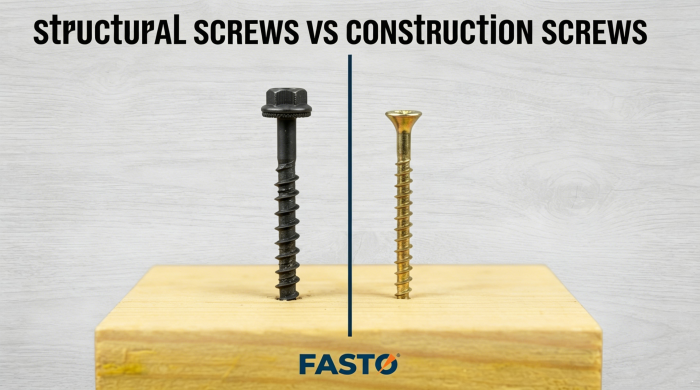


Fasto Structural Screws vs Construction Screws: Key Differences & Uses
Construction Screws are the screws people use every day for building things. They are good for carpentry and finishing work. You can use them for light assembly too. These screws are made for wood and for outside. They do not have a rating for how much weight they can hold. So you should not use Construction Screws for the parts of a building.
Structural Screws are screws that are made for holding a lot of weight. They are screws that engineers have designed for important connections in buildings. The ICC-ES has certified them. They meet the codes for building. You can use Structural Screws instead of traditional lag screws, and they may substitute nails in select structural connectors where explicitly permitted by the connector manufacturer's load table and installation instructions.
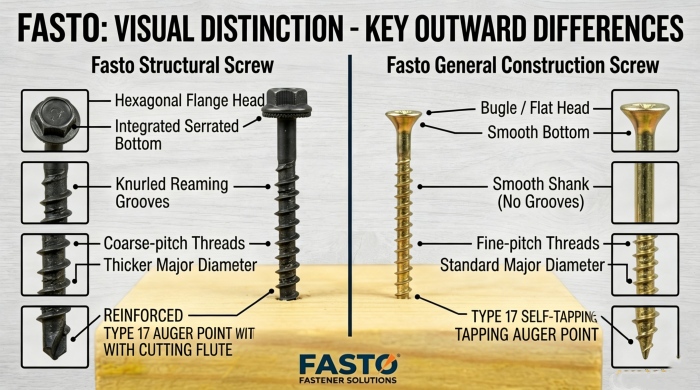
| Feature | Construction Screws | Structural Screws |
| Load Rating & Code Approval | No official shear and tensile load values; not code-listed for structural assemblies | ICC-ES certified with published shear & pullout strength data; legally approved for all load-bearing joints |
| Material & Hardening | Typically carbon steel; may be heat-treated or unhardened depending on grade. Coatings range from basic zinc to multi-layer ceramic/polymer systems for exterior use | High-carbon case-hardened steel or 305/316 stainless steel; features ultra-high shear and tensile strength |
| Shank & Thread Design | Smooth upper shank with standard coarse wood threads; no reaming knurl design | Thickened reinforced shank with rolled heavy-duty threads; most equipped with reamer knurls under the head to clear wood debris, with partial or full auger threads |
| Head Style | Common bugle head, small pan or truss head with limited bearing surface | Large washer or hex flange head with anti-slip serrations at the bottom; wide bearing surface for uniform load distribution |
| Point Tip | Standard Type 17 self-tapping auger point, suitable for general wood fastening | Reinforced Type 17 auger point with cutting flute for reduced driving torque; may eliminate pre-drilling in softwood species per manufacturer instructions, though pilot holes remain recommended for dense engineered lumber (LVL, glulam) with larger diameters |
| Coating Durability | Basic zinc coating with standard outdoor durability, only for mild external environments | Advanced corrosion-resistant coatings per manufacturer specifications (e.g., proprietary multi-layer systems meeting ACQ/CA compatibility and salt-spray requirements per ASTM B117) |
| Size Specification | Thin gauges (#6, #8, #10); conventional length within 3–4 inches | Heavy thick gauges (#12, 1/4", 5/16"); extended lengths up to 12+ inches for beam and ledger connections |
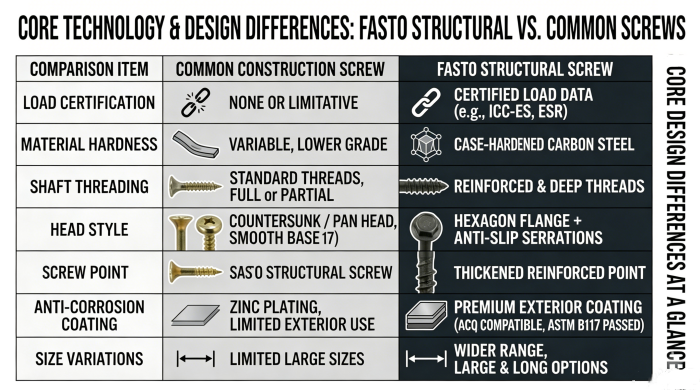
Suitable for non-load-bearing and decorative construction scenes only, including drywall installation, cabinetry fixing, interior trim and fascia board assembly, deck surface boards, fence slats and lattice installation, shed siding and gazebo cosmetic framing, furniture assembly and all light wood-to-wood non-structural joints.
Designed for core load-bearing structural connections: deck ledger to house rim joist connection, floor joist hanger fixation, rafter and roof truss assembly, beam splices and LVL/glulam girder fastening, wind and hurricane uplift resistance structural connections, stair stringers and post-to-beam support fixation, heavy timber framing and load-bearing pergola post installation. It can replace traditional lag screws for more efficient construction.
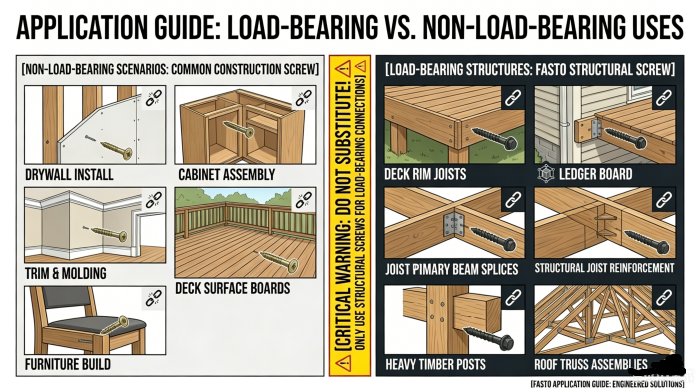
- 1. Non-substitutability principle: Construction screws are forbidden to replace structural screws for load-carrying joints. Without verified shear and pullout strength, they will fail under live load, wind load and seismic load, violating building code regulations.
- 2. One-way usability: Structural screws can be used for light finish work (overqualified but safe), while construction screws are illegal for all structural load-bearing connections.
- 3. Engineering practicability: Structural screws are equipped with official load tables for engineers and builders to accurately calculate joint bearing capacity; no standard load data is available for construction screws.
Fasto structural screws are heavy-duty, engineered fasteners designed for load-bearing structural connections. Made of hardened high-carbon steel with upgraded coatings, they feature thicker shanks, reamer knurls, and reinforced Type 17 auger points to deliver high shear and pullout strength. Code-rated and corrosion-resistant, they are suitable for deck ledgers, joist connections, timber framing, and other critical structural joints. In contrast, Fasto construction screws are standard general-purpose fasteners for light, non-structural finishing work. With standard carbon steel and basic threading, they offer only basic holding power without official structural load ratings. They are ideal for trim, siding, drywall, and decorative assemblies but should never replace structural screws for safety-critical building connections.